
Raised to Walk with C.M. Alvarez

Raised to Walk with C.M. Alvarez

Ethics of the Matrix

On consumerism, individualism, and the insufficiency of relativism.

Carla (C.M.) Alvarez's avatar
Carla (C.M.) Alvarez
Dec 05, 2024
∙ Paid

Do you want to know what it is, Neo?

It's that feeling you have had all your life. That feeling that something was wrong with the world. You don't know what it is but it's there, like a splinter in your mind, driving you mad, driving you to me. But what is it?[1]
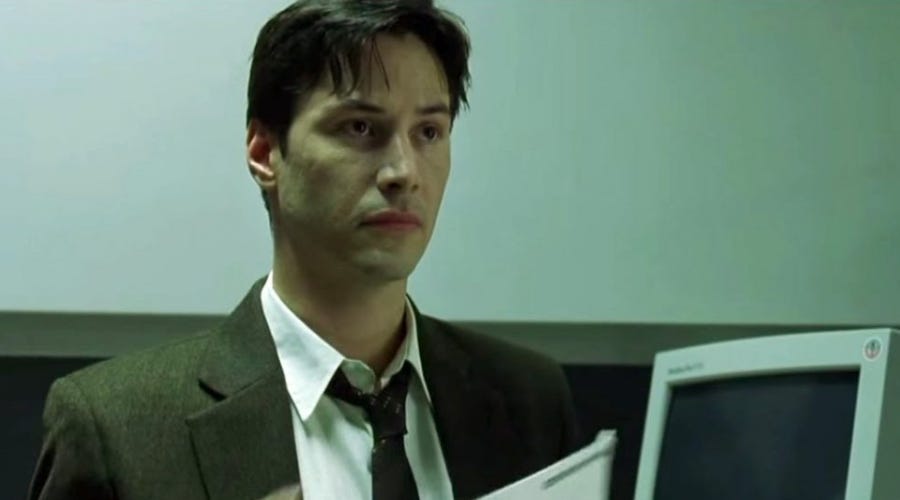
In an unnamed future, Neo, a computer programmer by day and hacker by night, goes through the monotony of what he believes to be the grind of his day-to-day existence looking for meaning. Prompted by the sense of an elusive “other,” of something beyond the world in front of him, he searches lines of code hoping to find the answer.

He believes the answer to be centered in a person called Morpheus, an elusive legend, a phantom voice whispered among the internet underground who is believed to have the answers to a greater system called the Matrix. The day comes when Neo is called by Morpheus, called out of his mundane existence, and given the opportunity to discover “the truth,” to see the world as it really is. Neo discovers what he believed to be reality was nothing but a facade designed to placate and control. Rather than an autonomous agent, he has been nothing more than property, a resource for a merciless controller. The Matrix highlights questions of both ethics and imaging.

MORPHEUS

This is your last chance. After this, there is no going back.

You take the blue pill and the story ends. You wake in your bed and you believe whatever you want to believe.

You take the red pill and you stay in Wonderland and I show you how deep the rabbit-hole goes.

Remember that all I am offering is the truth. Nothing more.[2]

When Neo first encounters Morpheus, Neo is presented with a choice in the form of two pills: a blue pill and a red pill. Choose the red pill, and Neo sees the unvarnished truth of the world as it actually is. Take the blue, and he continues life as he always had. As Neo reaches for the red pill, Morpheus warns, “Remember, all I am offering is the truth. Nothing more.”[3]

The red pill activates a trace program, and Neo discovers that he, as his true self, is not actually what he believed himself to be. Rather than a maverick anti-authority computer programmer chasing the limits of the network and bending it to his will, he was a slave to it. The idea he had of himself was a product of a virtual reality system, a “neural interactive simulation,” that controlled every area of his perception. In truth, he was a prisoner trapped in a pod among a field of countless other humans all being harvested for energy to fuel the artificial intelligence that controlled the Matrix.

The year was not actually 1997 as Neo believed, but 2197 . . . as far as he knew. The exact details of human history had been destroyed along with the earth in a battle between humans and AI. As Morpheus explained, “It started early in the twenty-first century, with the birth of artificial intelligence, a singular consciousness that spawned an entire race of machines.”[4] This new race wanted the same treatment as humans, at first, the same “inalienable rights,” but “whatever they were given, it was never enough.”[5]

Imago Dei vs Imago Hominis

The relationship between God and man begins with the words in Genesis 1:26, “Let us make man in our own image.” It is this connection that begets the relationship which fuels the desire for a connection with the one we image, as the writer of Ecclesiastes states, “God put eternity into the hearts of man.”[6] This being made in the image of, what Irenaeus of Lyons referred to as the Imago Dei, is the essence of humanness. We are more than our bodies, simply matter. We are more than feelings, soul and mind. It is the spirit, the God-breathed “spiritual divine spark or seed” that makes us not only unique from the rest of creation, but it is the conduit through which we can reconnect to God.[7] As Thomas Weinandy explains, “Thus, for Irenaeus, to be simply human clothes us with a dignity that is inconceivable, a dignity that pertains not to some spiritual aspect of our being, but to our very created humanness.”[8] It is this imaging that gives us this idea of goodness, of right. There is a particular way things should be even though they aren’t, or as Morpheus put it, “that something was wrong with the world.” Why should we believe there is a right way if corruption, brutality, and exploitation are just part of the way the world has always been? How in the heavens can we have any expectation of something else unless it is heaven itself that gives us this idea?

This certainty that there is a “should be” is what Thomas Aquinas refers to as the “argument from degree” or a “gradation of being” in his five ways to know God.[9] As each of us is created in the image of God, so we have an inner knowing of what is true, beautiful, and right. The fact that we all have an idea, an inner conviction, that a thing “should be” a certain way indicates that there is an ideal to be measured against. When an artist paints a picture of a person, the way we determine if it is “good” or not is by how well it resembles the person, either in depicting the person exactly or by highlighting a characteristic or trait of the individual. In the same way, a reproduction of a painting is considered to be “good” if it closely resembles the artist's original style and form.

In the same way, Aquinas’s Fourth Way states that we can know the evidence of God because we recognize that there is something that is the standard of perfection. In “On Goodness and the Goodness of God,” he defines the good as something that is “properly actual.”[10] Good refers to the perfected; everything else is an approximation or shadow. Our definition of personal good is based on its relation to the ultimate act or being. This spectrum of similarity or dissimilarity to the good is referred to as a “gradation of being” in Aquinas’s Fourth Way.[11] As Van Gogh’s “Starry Night” is the cause of all its imitations and it is the most, the ultimate, and the perfected version of itself; God is the ultimate being to which all likenesses are compared.

This idea that not only is there an objective “right” but one that all should work towards is something C.S. Lewis identified as universal and labeled the Tao or “the doctrine of objective value, the belief that certain attitudes are really true, and others really false, to the kind of thing the universe is and the kind of things we are.”[12] While the idea of a good and a perfection that we should all be seeking is a universal desire, the idea of good gods is not. As Thomas Weinandy explains in his essay, “Irenaneus and the Imago Dei,” “Within classical paganism, it was the gods who were modeled after the image and likeness of men and women and, in so being depicted, they possessed all of the foibles, weaknesses, and vices that human beings possess.”[13] As ancient humans created gods in their own image, so do modern humans create AI in the world of The Matrix.

But what happens to the imager when the Image is flawed? As Louis Markos writes in Apologetics for the 21st Century:

Only a God who is separate from his creation can function as the Guide and Embodiment of pure moral goodness. If pantheism is correct and God is indistinguishable from his creation, then he can neither be good nor evil--he can only be an amoral spiritual force. In pantheistic religions, the gods do not live outside time and space but are themselves born out of the primal (material) chaos, they do not embody either a holy or universal standard and thus cannot serve as the source of our idea of the good.[14]

In other words, there is no good without God, and there is nothing to have mercy towards. A being can be no better than the one who formed it, and the AI of the Matrix could be no better than the humans that developed its logic and code. Flawed human values would be its values. Humanity’s moral imperative became its imperative. As we see, the AI race followed in the footsteps of its makers exactly, whatever they were given . . . it was “never enough.”

The crux of the dilemma in The Matrix spotlights the consequences of departing from Judeo-Christian values. These Judeo-Christian values spawned the idea of individual rights that are equal to all.[15] This equality of persons is also not something common to all historical human experience or in all religions.[16] Buddhism teaches that there are levels of enlightenment, and one is condemned to repeat their life lesson until that lesson is learned.[17] A stratification of society is embedded into Hinduism with the varnas or castes.[18] But this specialness of not only the human race, but the preciousness of the individual sparkles like gemstones throughout the pages of the Hebrew scriptures. God cares about man himself.[19] God tabernacles among man, and man images God himself.[20] It is this last statement that guarantees value to every man.

But in the move from looking to God as the source of the image to man and the source of goodness, the humanists of the Enlightenment left God and focused on man alone. Without God as the grounding, the individual man is left as supreme authority. As Lewis warns, without that Divine grounding, there is nothing in man to check himself. That grounding Good is removed, and man’s own wants and desires are seen as the ultimate goal.

The desire to seek remains, but when there is nothing left but man, something must still be sought leaving man to seek things. The Matrix portrays a natural end to this individualistic mindset. It was just as C.S. Lewis warned in The Abolition of Man, “But the man-moulders of the new age will be armed with the powers of an omnicompetent state and an irresistible scientific technique: we shall get at last a race of conditioners who really can cut out all posterity in what shape they please.”[21] There came a time when the interests of the human and AI races clashed. When the offspring of the human race became too much of a threat, humans tried to annihilate their creation by scorching the sun. In a move worthy of the race they imaged, AI reflected human ingenuity by finding a new source for survival, enslaving and feeding off the humans who made them. AI rejected and abused their makers, just as humans rejected and killed their Source.[22]

Ethical Grounding and Society

When property becomes the prime directive, ethics become relative. In a study on ethical ideologies, D.R. Forsyth noted that as an individual’s income increased, they tended to become “situationalists.” They believe that there is right and wrong but do not accept a universal right.[23] The implication is that while they may very strongly believe that there is a right, without an absolute standard of rightness outside of themselves, their “right” becomes centered in themselves. This becomes a conflict for society as a whole when a particular person or group has the power to preserve their rights at the expense of others. As theologian John Stott observes, "Nearly all legislation has grown up because human beings cannot be trusted to settle their own disputes with justice and without self-interest."[24] Without a grounding in an absolutely just Good, we are left to the will of those who can control the most. As the hrossa in Out of the Silent Planet note on the futility of trying to live without a Lawgiver, “They are like one trying to lift himself by his own hair—or one trying to see over a whole country when he is on a level with it—like a female trying to beget young on herself.”[25] We cannot give what we do not have. The greedy cannot give equity. The exploiters cannot give justice. Without a Great Good, an “I AM,” we are, like the humans of the Matrix, left to the mercy of whoever is willing to be the most ruthless.

Breaking the Matrix

CYPHER

Just between you and me, you don't believe it, do you? You don't believe this guy is the one?

TRINITY

I think Morpheus believes he is.

CYPHER

I know. But what about you?

TRINITY

I think Morpheus knows things that I don't.

CYPHER

Yeah, but if he's wrong —

The human race, both those plugged in and unaware and those fighting it, are trapped in a prison of their own devising. But in this humanistic dystopia, the gleam of the “other” shines through. There is a prophecy of “The One” who will break the power of the Matrix and free the human race. They will be able to live in the city of Zion in peace. It is based on this promise that Morpheus calls out Neo from his bondage within the Matrix. He believes Neo is the One so strongly that he is willing to sacrifice his own life to save Neo’s. This Messianic theme is so strong, moviegoers have remarked, “When I was watching the film, I kept getting Messianic feels, like how someone is destined to swoop in and save everyone.”[26]

The ending is also Messianic — Christlike — a sacrificial death, a resurrection through the power of love, and an overcoming so completely of the Agents of the Matrix in a scene reminiscent of the Harrowing of Hell, that the Matrix loses all power over Neo. In a sense, “all authority” has been given to Neo, both within the Matrix and without.[27]

After the Breaking: The New Beginning

One has to wonder if Neo is successful in dismantling the Matrix, what is next? If the AI overlords are defeated, will the human race fare any better? It seems the Watchowskis did not have an answer to that question either. The Matrix Reloaded (2003) and The Matrix Revolutions (2003) descend into nihilism with the enemy losing its teeth, the hero his purpose, as well as the end vision of true deliverance.[28] When there is nothing outside of the world, there is nothing but the world to look to. There is no escape and nowhere to go, so the Watchowskis reboot to the beginning. For all its Messianic beginnings, the trilogy ends in Buddhist-like purposelessness. What was the meaning of it all if it all ends as it began?

The Matrix can show us the danger of a relativistic worldview giving warning of where our avaricious path may lead, but it cannot give us a vision of hope. For that we must look to the One who is “the Son of God, this the Only-begotten, this the Former of all things, this the true Light who enlighteneth every man, this the Creator of the world, this He that came to His own, this He that became flesh and dwelt among us”[29] Like Neo who overcame the hold of the matrix, Jesus became one of us to break the hold of our own Matrix, the power of sin.[30]

Await Him that is above every season, the Eternal, the Invisible, who became visible for our sake, the Impalpable, the Impassible, who suffered for our sake, who endured in all ways for our sake.[31]
- -Ignatius of Antioch

To read the original, unedited version of “Ethics of the Matrix,” click here.


First published in An Unexpected Journal: Science Fiction (2020)

A downloadable version of this essay is available to paid subscribers.

User's avatar

Continue reading this post for free, courtesy of Carla (C.M.) Alvarez.

Or purchase a paid subscription.
© 2026 Carla Sallee Alvarez · Privacy ∙ Terms ∙ Collection notice
Start your SubstackGet the app
Substack is the home for great culture